Saturday, January 27, 2024

NAVIGATING THE MORTGAGE MARKET: TO WAIT OR NOT TO WAIT?

Recent weeks have witnessed a significant drop in mortgage rates, bringing a breath of fresh air to homebuyers who were previously grappling with high borrowing costs. This sudden shift has sparked a dilemma for potential buyers: Should they seize the opportunity in the current market or wait for the possibility of even more favorable conditions?


The current consensus among forecasters is that mortgage rates may continue to decline, driven by the Federal Reserve's expected cuts to its benchmark interest rate later this year. While this creates a tempting prospect for buyers, the decision to enter the market now or await further developments is not without its complexities.

Experts suggest that homebuyers stand to benefit from taking advantage of the current market dynamics. The movement of mortgage rates is notoriously challenging to predict, and purchasers retain the flexibility to refinance if rates continue to fall. "If you need to buy a property, go ahead and buy it. Don't try to time the market," advises Marti Subrahmanyam, a professor of finance and business at New York University.

However, this approach is not without its risks. Critics highlight the potential loss of additional time to bolster one's finances and the risk of a decline in home value if market conditions worsen post-purchase. The unpredictability of the real estate market adds an element of uncertainty to the decision-making process.

Last year saw mortgage rates reaching their highest levels in over two decades. However, recent months have seen a sharp decline, with the average interest rate for a 30-year fixed mortgage standing at around 6.6% as of last week, according to FreddieMac. This marks a significant drop from the peak reached in October.

The fall in mortgage rates aligns with the Federal Reserve's plan to cut interest rates this year by an amount equivalent to three quarter-point reductions. Such a move would reverse a series of rate increases over the past year that led to soaring mortgage rates.

Experts note that even though mortgage rates could continue to decrease, making the leap into the market now makes sense due to the unpredictable nature of rate shifts. Julia Fonseca, a professor at the Gies College of Business at the University of Illinois at Urbana-Champaign, warns against delaying a purchase in hopes of better terms in the future, stating, "It's very hard to time the market."

While the potential for further rate drops exists, the efficiency of refinancing provides buyers with the option to adjust their mortgage terms if rates move downward. Experts emphasize that households should make housing decisions based on their needs, considering factors beyond just borrowing costs.

However, this strategy is not without drawbacks. Moving quickly into the market could limit the time available for saving before shouldering the significant expense of a mortgage. Additionally, there is the risk of purchasing a house just before a market decline, potentially leading to a rapid loss in home value.

Despite these considerations, optimism about the U.S. economy's outlook has grown, with expectations of a slowdown rather than a contraction in the coming year. Experts emphasize that the decision to buy a house should be a personalized assessment, taking into account various factors that extend beyond the current state of borrowing costs.

In the end, the choice to enter the housing market requires careful consideration of individual circumstances, with the understanding that predicting long-term interest rates and market fluctuations remains a challenging task.

Click Here For the Source of the Information.

Monday, January 22, 2024

NAVIGATING 2024: HOUSING MARKET POISED FOR RECOVERY AMID CHALLENGES

The housing market is set to undergo a significant transformation in 2024 after facing two years of sharp declines, according to insights shared at the National Association of REALTORS® (NAR) virtual Real Estate Forecast Summit. Despite a rocky 2023, where existing-home sales are projected to be 18% lower than those of 2022, experts are optimistic about a rebound in the coming year.

NAR Chief Economist Lawrence Yun, along with other housing analysts, discussed the projections for 2024, highlighting key factors that are expected to shape the real estate landscape. One of the pivotal factors contributing to this positive outlook is the expected easing of borrowing costs. Mortgage rates, having likely peaked and now on a downward trajectory from their recent high of nearly 8%, are anticipated to improve housing affordability.

NAR predicts the 30-year fixed-rate mortgage to average 6.3% in 2024, while realtor.com® projects 6.5%. This drop is expected to entice more home buyers back into the market. Rates near 6.6% enable the average American family to afford a median-priced home without exceeding the commonly used threshold of 30% of their income devoted to housing, as per NAR's data.

The projections indicate a positive shift for existing-home sales, with an expected rise of 13.5%, and new-home sales, which have defied market trends by increasing about 5% this year, potentially seeing a 19% increase by the end of 2024.

Several U.S. metro areas are identified as having the most pent-up housing demand for 2024. Markets such as Austin, Dallas-Fort Worth, and Nashville are among those expected to experience higher sales upticks, driven by job growth as a determinant for long-term housing demand.

However, the optimistic forecasts come with a wildcard – inflation. While experts are hopeful about improvements in overall inflation, concerns arise about its potential impact on long-term interest rates. If inflation doesn't continue to improve, there is a risk of discouraging homeowners from selling and prolonging inventory bottlenecks. Younger generations may face challenges as higher housing costs keep them on the sidelines as renters.

Inflation, though easing overall, is still influencing shelter inflation, a factor crucial to housing costs. The rise in apartment units may help control inflation by bringing rental rates down, providing some relief. Panelists at the summit stressed the importance of monitoring inflation data closely to understand its implications for the housing market.

Challenges persist in the housing market, particularly for first-time buyers and amid record low inventory. Homeowners remain hesitant to sell, and homebuilders have underproduced for decades, resulting in a nationwide shortage of 5 million housing units.

Despite these challenges, current homeowners stand to benefit. Rapid home appreciation in recent years has positioned homeowners to grow their nest egg in 2024. Even in markets expecting slight dips, homeowners have accumulated significant housing wealth. NAR data shows that the typical homeowner has amassed more than $100,000 in housing wealth over the past three years. Comparatively, homeowners have a substantial wealth advantage over renters, with a typical homeowner having $396,200 in wealth versus $10,400 for renters, according to Federal Reserve data.

While challenges persist, the 2024 housing market holds promise for recovery and growth, presenting opportunities and considerations for both buyers and sellers.

Click Here For the Source of the Information.

Friday, January 5, 2024

EXISTING-HOME SALES SHOW SLIGHT GAIN, INDICATING A POSITIVE TURN FOR THE REAL ESTATE MARKET IN 2024

Existing-home sales in the United States posted a modest increase last month, breaking a streak of five consecutive monthly declines and hinting at a more favorable outlook for the real estate market in the coming year. According to a report from the National Association of REALTORS® (NAR), completed transactions for single-family homes, townhomes, condos, and co-ops rose by 0.8% in November.

NAR Chief Economist Lawrence Yun anticipates further growth in the upcoming months, attributing the positive trend to a decline in borrowing costs. Mortgage rates, which averaged 6.95% last week, have eased from their recent peak of nearly 8% earlier this fall. Despite this improvement, November's existing-home sales were still down by 7.3% compared to the same month the previous year.

One factor contributing to the challenges in the housing market is the continuous rise in home prices, driven by persistently low inventory. In November, prices surged by 4% year over year, reaching a median of $387,600. Lawrence Yun notes, "Only a dramatic rise in supply will dampen price appreciation."

The scarcity of housing inventory remains a significant hurdle for homebuyers, with many homeowners who secured low mortgage rates in previous years reluctant to sell. Although total inventory saw a marginal increase of 0.9% year over year, it was down by 1.7% month over month in November.

To address the shortage, homebuilders are increasing construction efforts, with single-family home construction experiencing an 18% surge in November compared to the previous month and a notable 42% increase compared to the same period the previous year. The National Association of Home Builders (NAHB) is optimistic about a 4% rise in single-family starts in 2024, anticipating lower mortgage rates and reduced inflation.

Despite higher home prices and mortgage rates, buyers remain resilient, engaging in bidding wars for limited inventory. NAR reports that 62% of properties sold in November were on the market for less than a month, with properties typically selling within 25 days. First-time buyers are reemerging, constituting 31% of existing-home sales in November, up from 28% the previous year.

Cash sales are also on the rise, with 27% of transactions in November being cash sales. This trend is attributed to buyers leveraging proceeds from previous home sales and bypassing higher mortgage rates. Individual investors and second-home buyers lead in cash transactions, comprising 18% in November, up from 14% a year earlier.

Regional variations persist in the real estate market, with the South and Midwest experiencing strong home sales. NAR identifies several markets in these regions as having the most pent-up homebuyer demand heading into 2024. Austin and Dallas–Fort Worth, Texas; Dayton, Ohio; and Durham–Chapel Hill, N.C., are among the top 10 markets to watch in the coming year.

"Lower interest rates and a lack of resale inventory helped to provide a strong boost for new-home construction in November," says Alicia Huey, chairperson of the National Association of Home Builders. "And while these higher starts are consistent with our latest builder survey, which shows a rise in builder sentiment and future sales expectations, home builders continue to contend with elevated construction and regulatory costs."

As the real estate market adapts to changing conditions, the coming year holds promise for both buyers and sellers, with expectations of increased supply and more favorable mortgage rates.

Click Here For the Source of the Information.

Sunday, December 31, 2023

Parking in Downtown Covington

Downtown Covington is a popular spot, especially on the weekends. Parking spots are scarce during busy times and special events. City officials have been looking into this problem and have come up with a good solution.

The solution is to borrow the St. Tammany Parish Courthouse garage when large crowds plan to be in the area for a special event. A very popular event in the area, the Three Rivers Arts Festival, brings in crowds from all over.

The good news for the courthouse parking garage is that it is going to get a bit of a facelift. The city will start by improving the one-block area of the Tammany Trace that provides access to downtown from the courthouse parking garage. In its current state, it is not conducive for wheelchair-bound visitors.

“We all know that parking in downtown is one of our biggest challenges,” Mayor Mark Johnson said. By enhancing the walkway, “people will be able to park at the justice center (parking garage) and have easy access to downtown. It’s a win-win, win for us.”

The two hundred thousand dollar grant that was given to Covington from the state capital will pay for the improvements to the part of the Tammany Trace that runs between North Theard and East Lockwood streets. This area sits behind the old train depot and is at the north end of the pathway that runs from Covington to Slidell.

Since the courthouse is not open during the weekends, this is a great solution for the time being. The city does know that there is a need for more parking especially since there are many redevelopment projects underway in downtown Covington.

Click Here For the Source of the Information. 

Five Different Staircase Looks for Your Home

 Floating staircases have been popular for a while and they are designers’ favorite choice because they make a statement. They can be used as the focal point of a space. Here are some of the floating staircases that can set your home apart.

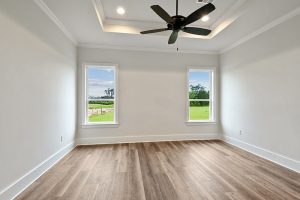
The master bedroom has nice rich hardwood floors and a custom ceiling fan. The trey ceiling is accented by recessed lighting.

Mono-Stringer Stairs

When designers use mono-stringer stairs, they are usually going for a classic look. This type of floating staircase uses a single steel beam that runs underneath each tread step. The classic look is seen through the exposed beam handrails made from cherry walnut or mahogany. This type of floating stair is great for a family room or a foyer.

A twist to the design is to use glass railings, aluminum handrails and tread wood such as maple or oak. This style lends itself to being flexible and can be built as a straight stairway, L-shaped, U-Shaped and switchback styles.

Dual-Stringer Style

A dual-stringer style staircase has two exposed steel supports that are at both ends of the treads. This gives the floating stair look with a grounding look as well. If you want to make a sleek yet dramatic look this should be your choice.

This type of floating staircase makes a great focal point for the space. If you want to draw your eye down towards your sitting room, then use this look. It especially draws the eyes with dark steel sup[ports and pale steps. Another idea is to use a glass railing which gives an added safety measure.

Cantilever

Many homeowners do not like the look of exposed steel so this is a good alternative. These stairs have a hidden support behind an adjacent wall. A true floating stair experience due to only the treads and railing being exposed. A glass railing is a perfect addition to this look and is great for a modern space.

Stacked Wood Stairs

Stacked wood stairs, also known as enclosed floating stairs is a great idea if you do not like exposed steel. The steel stringers are hidden in the wooden boxes that make up the tread. So that causes the tread to be stacked up on each other in a neat fashion. This is a softer touch to the more modern looks. Paired with a glass railing, heavy wood or metal handrail make them a nice artistic style for any space.

Spiral

One that is unique to its own is the saved for last and is the spiral staircase. The most modern design of floating staircases, this style is perfect for compact spaces. The open riser treads ascend helically around the weight-bearing steel pole and are enclosed on the other side by curved rod infill. LED lighting is a perfect touch underneath each step and will be a conversation piece.


Click Here For the Source of the Information.

Tuesday, December 12, 2023

Wood Siding vs. James Hardie Siding

 Both wood siding and fiber cement siding are popular materials to use on the exterior of your home. Although both are popular, they are both quite different.

When it comes to weather protection fiber cement siding such as James Hardie siding wins. Wood siding is great for insulation but as it gets older it will split, crack and splinter. This makes the material a bit more vulnerable to the elements. Hardie siding is built to withstand the outdoor elements including freezing temperatures, blizzards, hail storms, heat, humidity, rain and wind.

Hardie siding is moisture resistant due to the material that it is constructed out of. Hardie siding is a blend of sand, cement, water and cellulose fibers and will not swell, crack or warp from moisture. Wood siding will contract and expand when exposed to moisture. This is what causes it to crack and split which leads to deterioration. Mold, mildew and algae growth is also harbored in the damp wood.

To make a fire outdoors, you usually need wood, so with that being said, wood siding is not fire resistant. There are flame retardants that can be used on wood siding but have to be reapplied in order to be effective. Hardie siding is made from fireproof materials and is fire-resistant to a point. If exposed to a direct flame, it will not ignite or combust.

Wood will also attract a wide variety of pests. Natural wood is loved by termites, woodpeckers, squirrels and many other little critters. Hardie siding however is not a desirable material for any pests. It cannot be eaten or burrowed in.

Natural wood is beautiful and a timeless material to use for the outside of a home, but it does come with a lot of upkeep. It has to be painted or stained and well-maintained. Hardie siding comes with the look of natural wood with ColorPlus Technology. This means the fiber cement has the color baked on and factory-applied so it is resistant to cracking, chipping and fading.

Hardie siding is a perfect choice because it looks like natural wood with all of the benefits of the fiber cement. With Hardie siding you will have a timeless look for all types of designed homes.

Click Here For the Source of the Information.

Saturday, December 2, 2023

Winter Weatherproofing For Your Home

 As a homeowner, you want to keep your home well-maintained and this is especially important during the harsher winter months. Not only can weatherproofing your home protect it from the elements but can also add curb appeal and increase the value of your home.

EIFS stands for Exterior Insulation and Finish System which is a synthetic stucco. The material will protect your home from moisture intrusion and keep your home well insulated. A well-insulated home will not only lower your utility bills but it will also add an extra layer of insulation. This can also help enhance your curb appeal as well.

Your windows and doors can also let in the warm air in the summer and the cool air in the winter. A good way to make sure that the warm air stays in and the cool air stays out during the winter is to weatherproof your windows and doors. Replacing your windows and doors with energy-efficient ones can reduce drafts and improve energy efficiency. Plus a new window will boost your home’s curb appeal and add value to your home.

Another thing that should be well-maintained is the roof and the foundation. A roof is very important to your home’s protection from the elements. An energy-efficient roof will lower energy consumption and utility bills. All homes whether they have a basement or not, have a foundation that needs to be safeguarded from moisture. Water damage in a basement can not only damage the home’s structural integrity but can also cause an unhealthy indoor environment.

Weatherproofing your home is a great way to keep the outdoor elements out. You will not only help with making your home energy efficient but will also add value to your home. For more information on ways to finance one of these projects look into a Home Equity Line of Credit (HELOC).

Click Here For the Source of the Information.