Friday, December 2, 2022

Ways A Barn Door Can Transform A Space

 The pandemic changed the way we lived and used the spaces in our homes. Homeowners across the board wanted to add privacy and space to their homes. A great and practical piece that will do both is a stylish barn door. Here are three ways you can transform any room with a barn door.
1. Add Privacy

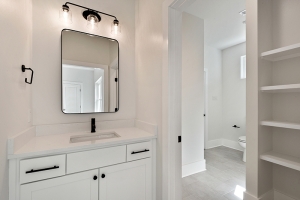
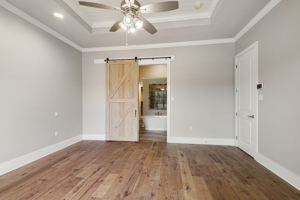
During the pandemic, the stay-at-home orders meant that we were all in our homes 24/7. Privacy and concealing unattractive space became very important. A barn door can add a good-looking feature to your space that can keep clutter out of view. A great example is concealing a children’s playroom. A barn door can hide the jumble of toys, games and books that can create chaos. A barn door can cover an open shelved kitchen pantry or create a door to an en-suite bathroom.

2. Refresh Your Style

Barn doors are a great look and are more design-forward than you might think. “Homeowners often consider barn doors a solution only in rustic homes,” Michael Truelove, senior product manager for interior doors at Masonite says, “but today’s styles can be anything from modern to industrial to classic and more. The great thing about barn doors is they cover a cross-section of design trends. I wouldn’t say one style is more versatile than the rest, since it depends on style preference and use case.”

3. Save Space

Even if you have a big home, a barn door can help with space issues. For example, if you have an area where a conventional door will not work like a narrow hallway. If you want to give a guest bath, a closet or even a small mudroom privacy and they flow out to a narrow hallway then a barn door will fix the issue. In the past, pocket doors have been our only option but they are not as easy to install or maintain. “Like pocket doors, barn doors take up less space than hinged doors, but in this case, all of the hardware, including the track, is outside of the wall and easy to access,” Truelove says.

Masonite is the perfect company for the job. “We make a few recommendations to ensure the best and safest installation of our doors,” Truelove says. “First, measure the width of your opening and available horizontal and vertical wall space to be sure you purchase the right size door, and read the instructions carefully before you begin.” Keep in mind the kits are designed to work as a total system and any modifications will void the warranty and may cause the unit to work improperly. Truelove recommends that, due to the weight of the doors, you don’t try to go it alone. “And don’t forget to wear appropriate personal protective equipment like gloves and safety goggles,” he says.


Click Here For the Source of the Information.

Thursday, November 17, 2022

Covington's Southern Hotel to Expand

 The place residents and tourists go in downtown Covington is North New Hampshire Street where the Southern Hotel is located.  The Southern Hotel not only is a place for visitors but also holds several movie houses that show all genres of films.  Within the next couple of years, The Southern Hotel will see another expansion. The project will take The Southern Hotel and expand it to cover the entire block.

A patterened wall paper sets this powder room apart. The fixtures in this powder room are simple and handsome in design.
Along with the expansion, there will be a new restaurant by BRG Hospitality and a renovated Star Theater. The Star Theater will offer a boutique bowling alley, upscale lounge and music stages.  The expansion has around $17 million in new investments and will be considered the largest transformation of the historic district since the renovation of The Southern Hotel in 2014.
The Southern Hotel boasts 48 rooms and is a boutique-style hotel in the heart of downtown Covington.  With the expansion, it is planned to add additional rooms, condos and retail space.  The retail space will be modeled after the 1940s-era storefronts and there will be an additional 43,000 square-foot Mission-style building built on land.  The new building will be named the Summer House and have retail space on the first floor,  hotel rooms on the second floor, a full-service spa on the third floor and four condos on the fourth floor.  The total new building will cost around $11 million.
The Star Theater, a 1942 movie house, will be renovated and will be the largest of the downtown Covington Theaters.  The theater has been vacant since Katrina and before was split into two theaters in the 1970s. The $3 million to $5 million project will include a six-lane boutique bowling alley, and an upscale lounge.  Eventually there will be plans for a roof-top lounge with stages for small acoustic bands.
“We had gone past it so many times, I tried for six months to negotiate a purchase,” said Warren Salles referring to the Star.
The new restaurant by BRG Hospitality will be called TAVI and will be housed in a former barbershop and law office.  TAVI will be under Fariz Choumali, who has been leading the kitchen at Shaya, and will offer a Israeli-Lebanese inspired menu.
“Downtown is becoming a night-time destination, and we have to embrace that,” says Covington Mayor Mark Johnson.  The area has already begun to see an increase in activity since the restrictions from the pandemic were lifted.  “We’re not Mayberry anymore. We’re Mayberry on steroids,” says Johnson.

Tuesday, November 15, 2022

Is Downsizing in Your Best Interest?


Everyone thinks of downsizing once they are empty nesters or many homeowners just might want a change.  Downsizing your home does have many financial advantages as well as less upkeep but is it the best way to go when it comes to taxes?  When you downsize more than likely you will end up with cash from the sale of your larger home which could end up adding to a big tax bill.  
 
Currently if you sell your home (principal residence) for a profit, you could qualify to  knock off $250,000 ($500,000 for married filing jointly) of your capital gain.  In order for you to benefit from the maximum exclusion you will need to pass the ownership and use test by the IRS.  The IRS will want to make sure you have owned the home for the last two years and that you have lived in the home as your principal residence for the past two years (ending on the date of the sale).
 
The IRS does have exceptions to the rules when it comes to the ownership and use test.  For example, if you are moving before owning the home for two years because of a job change (seen as unforeseen circumstances) it is exempt.  Other unforeseen circumstances the IRS has are divorce or natural disaster.  In circumstances such as these, the IRS will allow the homeowner to prorate the exclusion.
 
A homeowner does not have to live in the home for two consecutive years just as long as a homeowner has lived in the home 24 months out of the five years prior to the sale of the home.  Also, you can only claim and exclusion once every two years.
 
Before you decide to sell your home, you will want to calculate your cost basis.  Do this by figuring out the capital gains on the sale of your home then subtract your cost basis from the selling price.  Your cost basis includes the purchase price along with settlement fees, closing costs and commissions associated with both the purchase and the sale. Take these and add to the cost of all the improvements you have

done to the home which will be your cost basis.
 
Determining if something is a capital improvement or repair is also important because capital improvement can be added to your cost basis but repair cost cannot.  Why?  A capital improvement will increase the value of your home, while a repair will just restore your home to its original condition.  For example, a new deck is a capital improvement while fixing your plumbing is considered a repair.  A new roof would be a capital improvement however, just replacing a  few shingles is just a repair.
 
If you are looking to downsize, you may want to consider whether to buy or rent.  Renting will release you from all the obligations of owning a home but you will not be building equity and you will have to answer to a landlord.  There is no right or wrong answer, it is a personal preference which is right for you.
 

Saturday, November 12, 2022

A Bright Future Might Be In Store For Single-Housing Home Construction

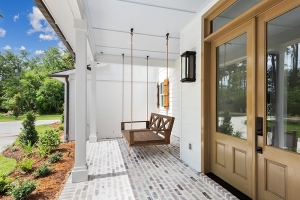
According to the Federal Reserve Bank of Kansas City single-family home construction is in store for a bright future.  A new study found that the years of underbuilding will come to an end.  This has left us in a deficit estimated at more than one million homes according to the National Association of Home Builders.The ceiling of this covered front porch is made of beam boards. The front porch swing is a perfect place to rock the evening away.
Jordan Rappaport, a senior economist at the Federal Reserve Bank of Kansas City, points out several points that align with the NAHB’s Home Building Geography Index data.  The key findings are on commute times, telework and home construction.  Those that work in a large metropolitan area, say that the largest concern about the suburbs is the commute.  The benefit is hybrid working which reduces commute time and expense.

The reduction in commuting will encourage more single-family permits but it will be a slow increase.  There are many headwinds that the National Association of Home Builders has reported that will prevent a quick boost in permits.  For example, when single-family construction begins to rebound, supply constraints are likely to slow its climb to its predicted long-term rate.  Moreover, shortages of workers, construction materials, and ready-to-build lots are all likely to constrain the growth of single-family construction in the short term.

Even with pushback, the jump in the construction of single-family homes will provide a long-term growth period for home building.  Once single-family home construction begins to ramp up, it is predicted to remain high for years to come.

Click Here For the Source of the Information. 

Are Building Material Prices Still Up?

The overall building material prices are down from summer prices except for the prices of ready-mix concrete.  In fact, the price of ready-mix concrete is rapidly rising.  The largest decline seen was in softwood lumber and steel mill prices.  Gypsum prices are still high over 20% from the same time last year.

Prices of building materials saw a 0.3% decrease in September according to the Producer Price Index (PPI). There was also a decline in the PPI for goods input to residential construction (including energy) for the third consecutive month in September.
Gypsum, which is used in drywall, is also an ingredient used in ready-mix concrete.  High demand for cement combined with lower imports of aggregate due to a large quarry shutdown in Mexico have spread thin the supply of domestically produced ready-mix concrete as well as gypsum.   Even though single-family house building is has slowed a little, concrete prices are still rising because it is used for many other applications outside of residential construction. Ready-mix saw a PPI increase of 1.4% this fall which marks the sixth consecutive increase.  This is the largest year-to-date increase in the index’s 34-year history.
Softwood lumber’s  PPI declined 2.9% this fall but the prices are still 14.5% higher than a year ago.  Steel Mill products saw a decrease of 6.7% this fall and have dropped 16.1% over the past four months.  In fact, the index is the lowest it has been since June 2021 which is still double the price that the steel mill was before COVID-19.

Home prices have decreased since last June 2021 2.3% which was reported to be the largest three-month drop since April 2020.  The small decline has happened during high prices on materials though.  In the South, there is a 2.6% increase, a 0.7% decrease in the Northeast, a 0.3% increase in the West and prices stayed the same in the Midwest.

Friday, October 28, 2022

IS THE HOUSING MARKET HEADING FOR A CRASH

The housing crash of 2008 was a devastation to the U.S. housing market.  Currently, the economy is slightly taking a negative turn.  The slowdown in the U.S. economy is having many homeowners concerned with the state of the market.  Fortunately, data reveals that today’s slowdown is nothing like the crash in 2008. One of the biggest factors for it not to crash down is the low inventory supply which comes from current homeowners putting their homes on the market, newly built homes being listed and short sales or foreclosures. 

Even with the uptick in housing supply, resales are still low.  Data shows that inventory is up 27.8%  which was the same time last year but compared to 2019 it is down by 42.6%.  This means that the current inventory is still super low because current homeowners are still hesitant to put their homes on the market.  This does not mean however that there are not enough houses on the market to cause a crash or prices to drop.  This would take a flood of current homeowners that would want to put their house on the market at the same time for this to happen.
Ironically even with such low inventory, homebuilders are slowing down their production currently.  “It has become a very competitive market for builders where they are trying to offload any standing inventory,” says Ali Wolf, Chief Economist at Zonda.
The slow down is a reaction to the higher mortgage rates and softening buyer demand. Builder’s do not want to overbuild like they did before the 2008 crash occurred.  Those in the industry say it is a sign that builders are being intentional about not overbuilding homes like what happened during the bubble before the 2008 crash.  The latest report from the U.S. Census states that at today’s current pace, we’re headed to build a seasonally adjusted annual rate of about 1.4 million homes this year. This is the perfect mix to make a stable market.  This will add more inventory at a pace that does not create an oversupply of inventory that the housing market can not absorb.  This is due to the builders being cautious about how much and how fast they are producing.
Distressed properties which are both foreclosures and short sales are another place inventory is pushed out in the market from.  In the 2008 housing crisis, there was an influx of short sales and foreclosures to flood the market in a short period of time.  This crisis was mainly due to the lenders allowing people to secure a loan they really could not afford the home.  Today’s market does not have to worry about this as much because lending standards are much stricter today than they were back then.  These tighter standards are pushing out more qualified buyers and fewer foreclosures.
Around the time of the 2008 crash, there were well over a million foreclosures per year.  When the lender’s tightened their reigns on lending standards the amount of distressed homes started to decline.  Also the introduction of the forbearance program in 2020 and 2021 has also aided in preventing a repeat crash.  This program gave homeowners the option for loan deferrals and modifications that were not there in the past.  And data on the success of that program shows four out of every five homeowners coming out of forbearance are either paid in full or have worked out a repayment plan to avoid foreclosure.
These three factors are the biggest reasons we will not see another big crash like we had in 2008.  Even though our housing supply is growing in 2022, it will not even touch the number of homes that would need to hit the market to saturate it and make home prices drop.  If you are in the market for a new home, contact a local real estate agent who can help you with the purchase of a new home.

Monday, October 24, 2022

SINGLE-NEW FAMILY HOMES ARE BUILDING IN THE SMALLER MARKETS

 According to the National Association of Home Builders (NAHB) Home Building Geography Index (HBGI) we are seeing a change in the locations of single-family home builds. The building activity in the last 30 months shows a decrease in building in metro areas, largely due to COVID, housing affordability and highly regulated markets.

“The geography of home building has shifted over the last two and a half years, with more single-family and multifamily construction occurring in lower-density markets.  This shift was first caused by the initial impact of COVID shift continued in recent months due to housing affordability conditions that are causing both prospective renters and buyers to expand their geographic search for housing, aided by hybrid work patterns that allow for a combination of remote office work,” said NAHB Chief Economist Robert Dietz.

Another wrench in the system is the problem with getting building materials, construction labor shortages and and the Federal Reserve’s stingent monetary policy.  “Looking at the last 12 months, single-family production has slowed in all regional submarkets, both large and small, due to ongoing building material production bottlenecks, construction labor shortages, and the Federal Reserve’s tigtening monetary policy,” said NAHB Chairman Jerry Konter, a home builder and developer from Savannah, Georgia.

The National Association of Home Builders Home Buidling Geography Index (HGBI)  is a quartley measurement of building conditions across the country and uses county-level information about single-and-multifamily permits to gauge housing construction growth in various urban and rural geographies.  The National Association of Home Builders tracks single-family and multifamily grow rates and market shares in all seven regions of the U.S. The HGBI takes the place of the of the Leading Market Index (LMI).  The LMI would base their findings off single-family housing permits, employment, and home prices.

Currently it is report that the market share for single-family home builiding in large metro core and inner suburbs too a dive from 44.5% to 41.6% from the fourth quarter of 2019 to the second quarter of 2022.  This shows the precovid vs postcovid figures, accounting for the results due to COVID. In the outer suburbs of large and medium metro areas has jumped up from 17.4% to 19% during the same time period as the decrease in the larger areas. The share also increased from 28.8% to 29% in the small metro core counties and in rural areas it rose from 9.4% to 10.4% This is mainly due to homebuyers wanting to move away from the dense areas during COVID.

Click Here For the Source of the Information.